
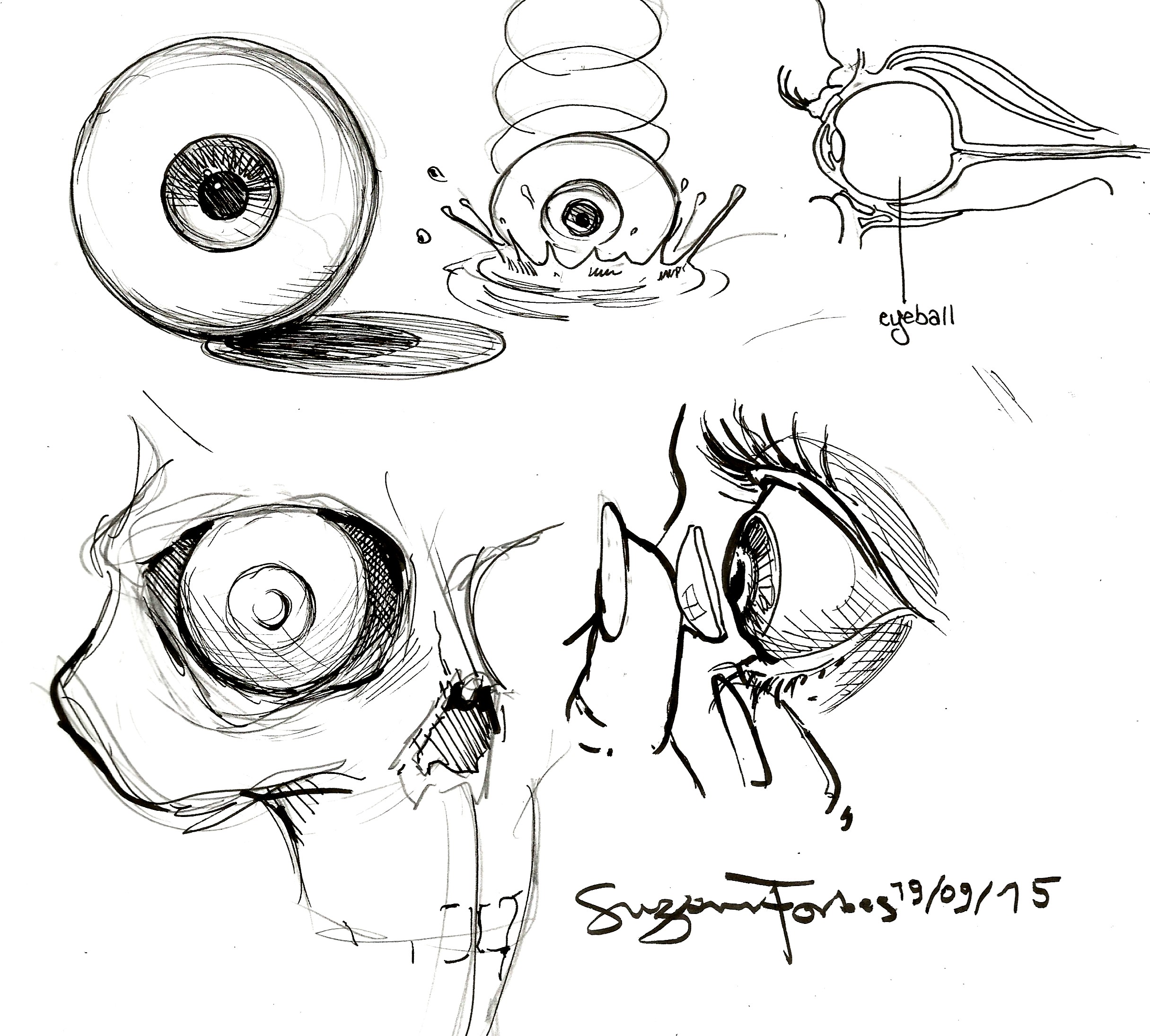
Your eyeball is a gelid sphere.
Intellectually, you know this. You can feel it, round as a ball bearing, spinning in the aqueous humour of your eye socket.
Yet most people instinctively draw the eye as two ellipses, meeting at their pointed ends. ()
 This is a perfectly serviceable beginning, but it’s only the beginning of understanding the proportions and dynamics of a human eye. First, consider the pupil. It takes up a relatively small amount of the eyeball sphere, but nearly a third of the visible eye.
We see only a section of the eyeball, one orange segment.
The rest is hidden behind eyelids and the fine skin that stretches over the eye socket, from the browbone and zygomatic arch. If you touch your eye sockets with your fingertips, you can feel all the eyeball underneath that thin skin, and all the floaty liquid that cradles your eyeball in its bone housing.
Your eyelids are like slices of baloney draped around your eyeball.
Like wrapping a baseball in horsehide, the eyelid skin has to follow the curve of the sphere. The skin has thickness of its own, a couple of millimeters.
The eyelashes project from the leading edge of the top surface of the eyelid, not from that couple-millimeter perpendicular plane. You’d be awfully sad if your eyelids didn’t have thickness.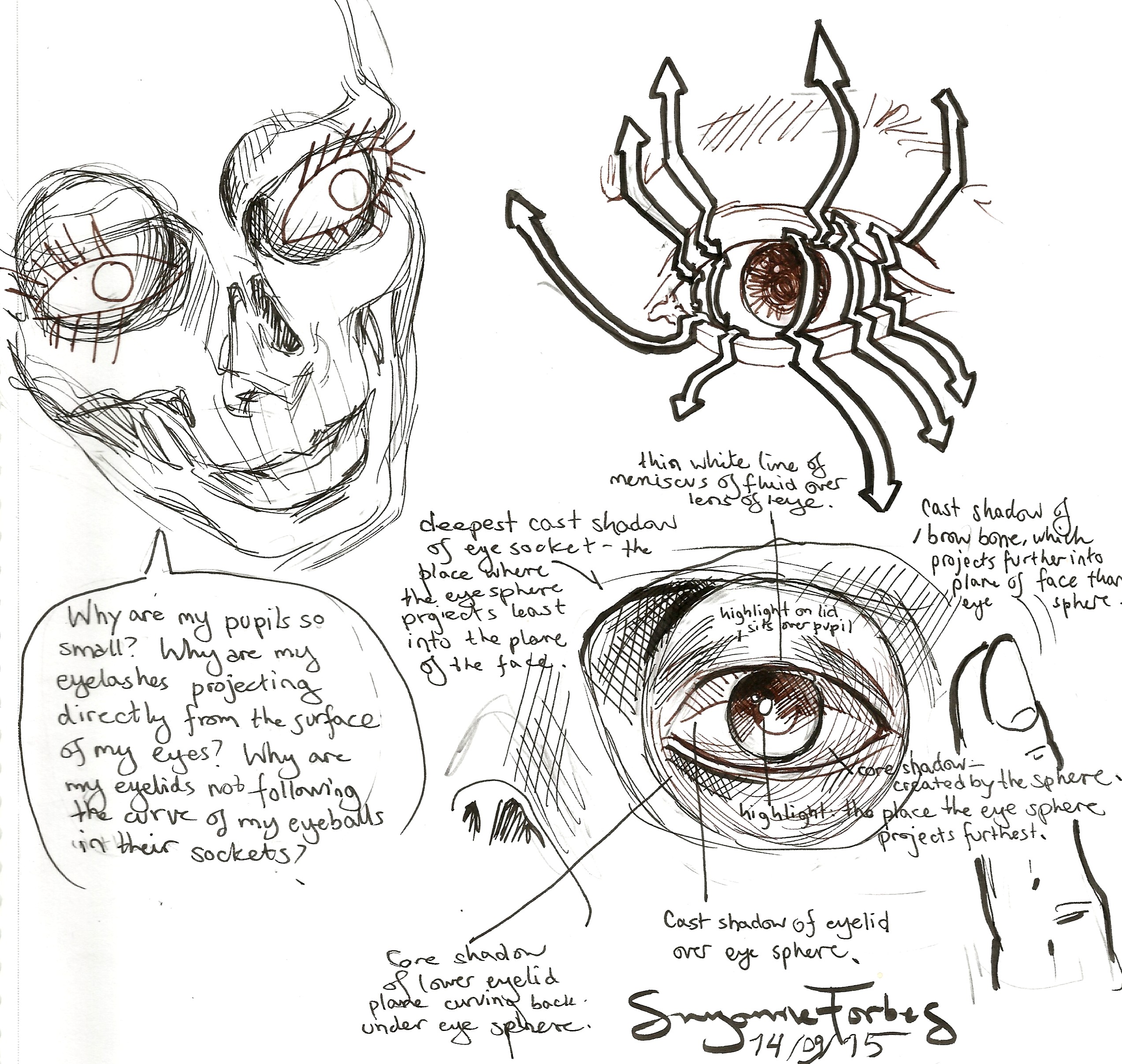
The pupil has dimension that makes it project forward a bit beyond the eye sphere, and when the thin eyelid passes over that extra dimension it makes a little extra curve to follow it. The highlight on an oily or made-up eyelid will be noticeably located over that curve.
Your browbone and cheekbones project further out than the corners of your eyes, because the sphere of your eye is smaller than the roundness of your skull.
Put your fingertip on the inner corner of your eyebrow, rest your palm on your mouth, and blink. You see how much space there is at the inner corner of your eye, where your tear duct is? If you have an epicanthic fold, that space will have thin skin stretched over it, but you can gently press to feel the curve of your eyeball. The sphere of your eyeball curves back into your skull, leaving a shadowed hollow below your brow. This also means that the whites of your eyes are brightest around the pupil and shadowed at the corners, by the core shadow of the sphere itself.
Your eyeball is shadowed by the thickness of your eyelid as well.
That cast shadow curves around the sphere just like the eyelids, and throws darkness into the top of the iris. The highlight on the pupil will sit right at this meridian of cast shadow. The shadowing of the iris is especially pronounced in people with an epicanthic fold, because the skin over the eyeball is projecting out further over the surface of the eye.
If you really want to understand the shape of your eyeball, try putting on false lashes a few times.
Very few experiences bring home the structure of the eye like the pain-in-the-ass process of applying falsies!
I hope this look at your gelid spheres is helpful; I’ll be happy to answer any questions in the comments.
That’s it for this time. Maybe next time we’ll talk about the most crucial thing you need to know to draw a perfect hand.